Understanding Attachment Theory: How Early Relationships Shape the Way We Love
Have you ever noticed that relationships seem to bring out the deepest parts of who we are?
Maybe you find yourself constantly worrying that your partner will leave, needing reassurance even when things seem okay. Maybe intimacy feels uncomfortable, and when someone gets too close, your instinct is to pull away. Or perhaps relationships feel relatively safe, and communicating your needs comes naturally.
These patterns are not random.
They often reflect something called Attachment Theory — one of the most important psychological frameworks for understanding how we connect with others.
Therapists often help clients explore attachment patterns because understanding how you connect can be the first step toward creating healthier, more secure relationships.
What Is Attachment Theory?
Attachment Theory was first developed by psychologist John Bowlby and later expanded by researcher Mary Ainsworth.
In simple terms, attachment theory explains how our earliest relationships — usually with parents or caregivers — shape the way we learn to experience:
Trust
Safety
Emotional connection
Independence
Vulnerability
Conflict
Intimacy
As children, we learn whether the world feels safe and whether other people can reliably meet our emotional needs.
Over time, these early experiences begin forming an internal blueprint for how relationships work.
This blueprint often follows us into adulthood.
The good news?
Attachment styles are not permanent.
With awareness, intentional work, and corrective emotional experiences, people can absolutely move toward secure attachment.
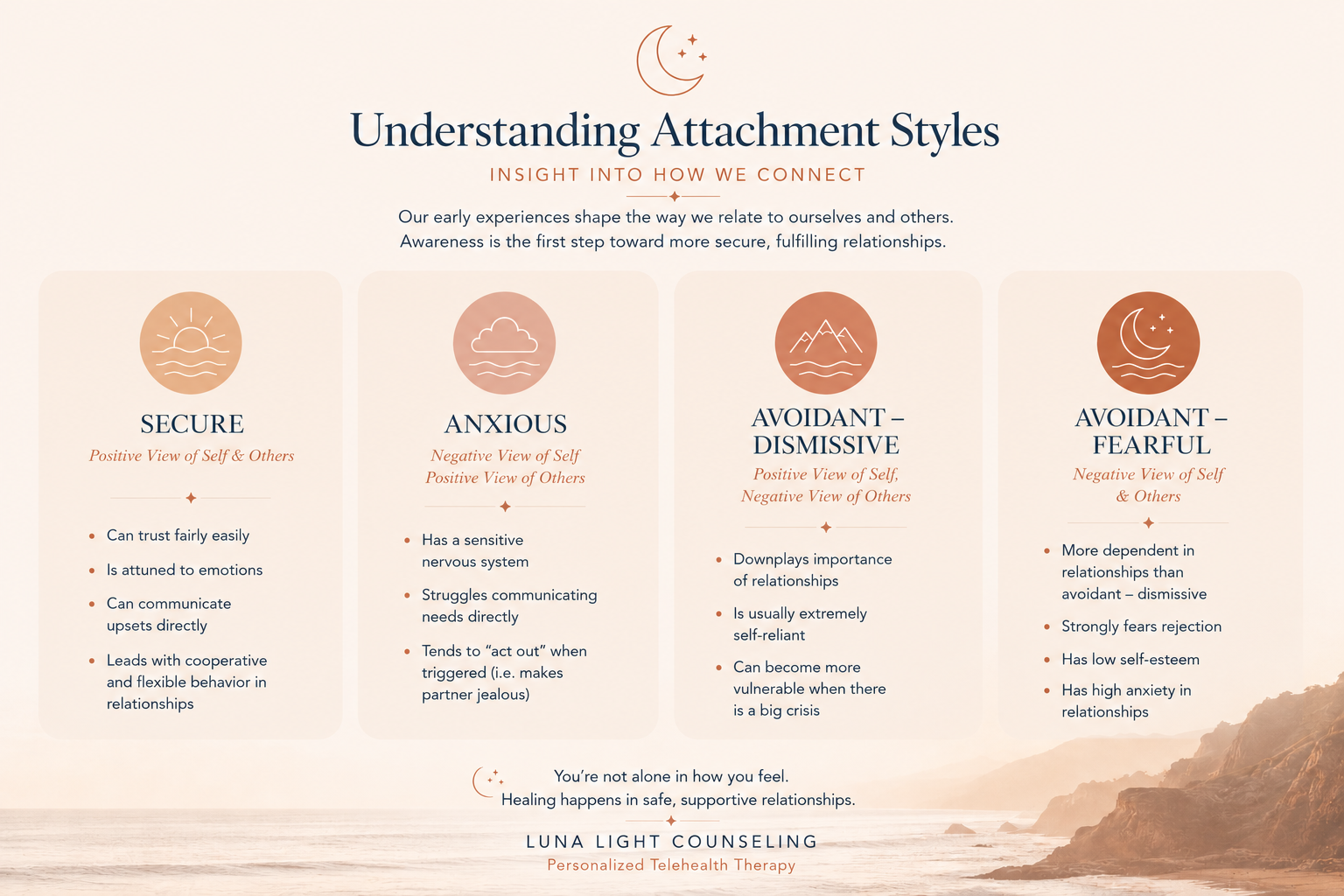
The Four Attachment Styles
1. Secure Attachment
People with secure attachment generally feel comfortable with closeness while also maintaining independence.
They often:
Trust others fairly easily
Communicate needs directly
Feel comfortable giving and receiving support
Recover from conflict without fearing abandonment
Maintain healthy emotional boundaries
Secure attachment often develops when caregivers were consistently responsive, emotionally available, and predictable.
2. Anxious Attachment
People with anxious attachment deeply desire closeness but often fear abandonment.
They may:
Need frequent reassurance
Overanalyze texts, tone changes, or shifts in behavior
Fear rejection even when relationships are stable
Feel highly sensitive to emotional distance
Become preoccupied with relationships
This pattern often develops when caregiving was inconsistent — love and connection sometimes felt available and sometimes unavailable.
At its core, anxious attachment often sounds like:
"I need connection… but I’m afraid you’ll leave."
3. Dismissive Avoidant Attachment
People with dismissive avoidant attachment often value independence so strongly that emotional closeness feels uncomfortable.
They may:
Pull away when relationships become vulnerable
Struggle expressing emotions
Minimize emotional needs
Feel uncomfortable depending on others
Prioritize self-reliance above connection
This often develops when emotional needs were ignored or discouraged early in life.
The internal belief may sound like:
"I can only rely on myself."
4. Fearful Avoidant Attachment
Fearful avoidant attachment tends to create an internal conflict.
People often want closeness but simultaneously fear intimacy.
They may:
Fear rejection deeply
Push people away when feeling vulnerable
Experience high anxiety in relationships
Struggle trusting others
Alternate between seeking closeness and withdrawing
This attachment style often develops in environments where caregivers were both a source of comfort and fear.
The internal experience can sound like:
"I want love… but love feels dangerous."
The Important Part: Attachment Styles Can Change
Many people assume attachment styles are fixed.
They are not.
The brain remains capable of learning new relational patterns throughout adulthood through a process called earned secure attachment.
This means we can gradually teach our nervous system that relationships can feel safe.
Therapy is one way to do this.
But healing can also happen outside of therapy.
How To Become More Securely Attached Outside of Therapy
While therapy can be incredibly helpful, there are also ways to begin building secure attachment in everyday life.
1. Notice Your Relationship Triggers
Attachment wounds often activate automatically. Pay attention when you notice fear after conflict, anxiety when someone pulls away, or discomfort with vulnerability.
Ask yourself:
“Am I reacting to the present moment, or an old emotional wound?”
Awareness is the first step toward change.
2. Learn to Regulate Your Nervous System
Attachment patterns are deeply connected to the nervous system. When triggered, the body often moves into fight, flight, freeze, or fawn.
Practices like deep breathing, meditation, yoga, walking, and slowing down can help create emotional safety from within.
Sometimes calming the body comes before changing the thought.
3. Practice Self-Soothing
If you struggle with anxious attachment, constant reassurance may bring temporary relief but can reinforce dependence on others for safety.
Instead, pause and ask:
Is this fear based on evidence?
Can I tolerate uncertainty right now?
Learning to comfort yourself helps build emotional security.
4. Practice Healthy Vulnerability
For more avoidant attachment styles, closeness can feel overwhelming.
Healing often means practicing small moments of openness:
Expressing feelings
Asking for support
Letting others show up for you
Secure attachment grows through repeated experiences of safe connection.
5. Choose Healthy Relationships
Surround yourself with people who offer consistency, healthy communication, respect for boundaries, and emotional reliability.
Safe relationships help teach the nervous system that connection does not have to feel chaotic.
Final Thoughts
Understanding attachment theory helps us recognize that many relationship struggles are not character flaws.
They are learned survival strategies.
Patterns that once protected us can begin limiting us as adults.
The beautiful part of healing is realizing that these patterns can change.
With self-awareness, healthy relationships, nervous system regulation, and intentional practice, secure attachment is something that can be built.
You are not stuck with the patterns you learned early in life.
Healing is possible.
Connection can feel safe again.