Have you ever jumped in to help someone you love, only to end up angry that they didn't appreciate it, and then alone with the feeling that you carry everything? If that loop sounds familiar, you may be caught on what therapists call the drama triangle. The good news: once you can see the pattern, you can step off it.
What is the drama triangle?
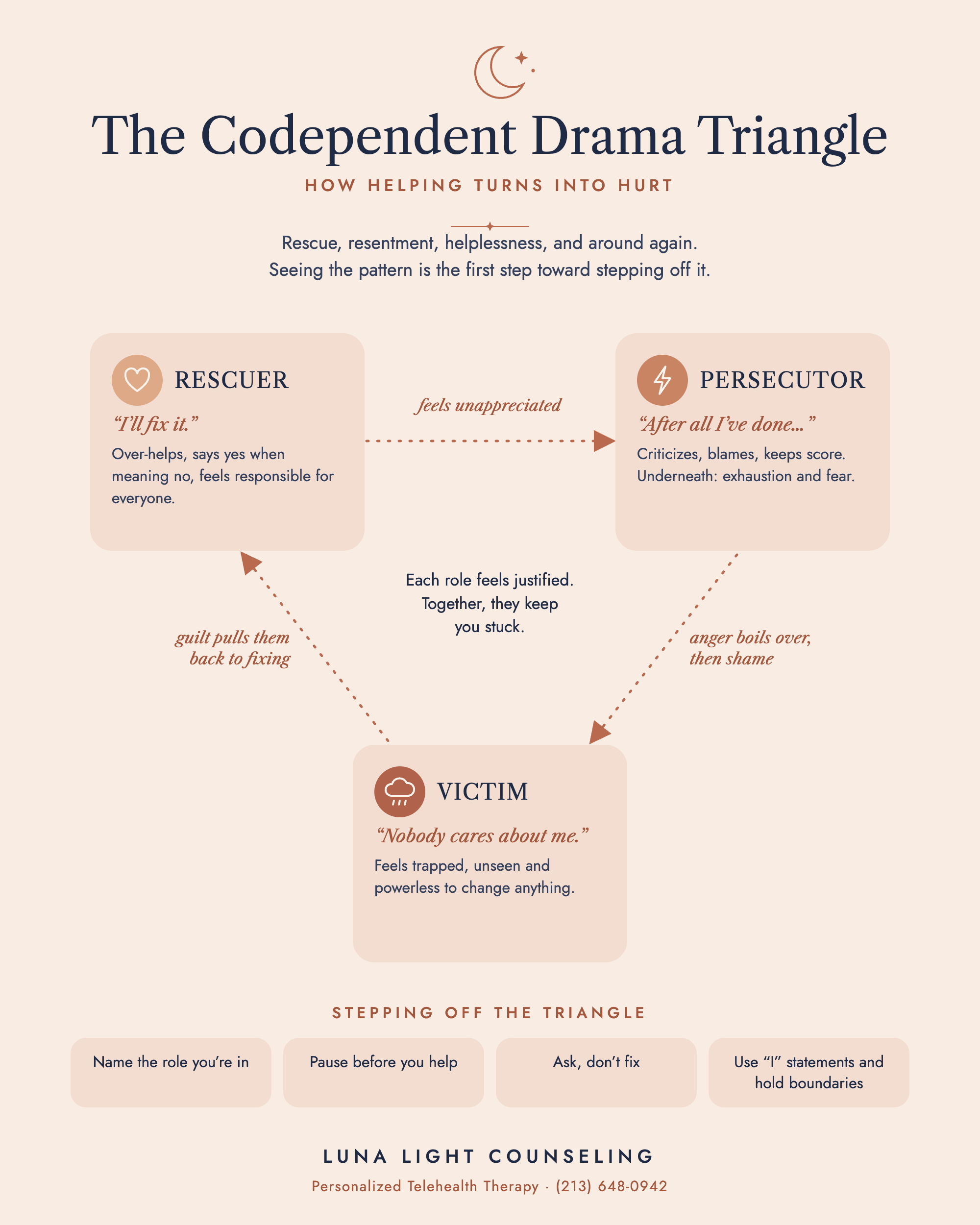
Psychiatrist Stephen Karpman first described the drama triangle in 1968 as a map of how conflict repeats between people. It has three positions: Rescuer, Persecutor, and Victim. Nobody stays in one spot. We rotate, sometimes within a single conversation.
Melody Beattie, author of Codependent No More, noticed that people with codependent patterns tend to travel the triangle in a predictable order. We start by rescuing. When that goes unappreciated, we turn resentful and blame. Then we land in feeling hurt, used, and helpless. And then, often, we start rescuing again.
The three roles
The Rescuer: "I'll fix it."
The Rescuer steps in before being asked. Fixing feels urgent, and being needed feels like proof of worth. You might notice:
Taking responsibility for other people's moods, choices, or problems
Saying yes when you mean no
Giving far more than you get back
Anxiety when someone you love is uncomfortable
There's a difference between rescuing and genuine care. Care is a free choice, offered when help is wanted. Rescuing feels compulsory, and it quietly sends the message "you can't handle this without me."
The Persecutor: "After everything I've done..."
When rescuing doesn't get the thanks or change we hoped for, resentment builds. The Persecutor criticizes, lectures, keeps score, or turns sarcastic. Underneath the anger is usually exhaustion and a scary sense of losing control.
The Victim: "Nobody cares about me."
After the blowup comes the crash. In the Victim position you feel trapped, unseen, and powerless to change anything. Shame and sadness are common here, along with a deep wish for someone to finally notice how hard you've been trying.
What it looks like in real life
Maya's adult brother keeps losing jobs and calling her when rent is due. (Maya is a composite, not a real client.)
Rescuer: Maya covers his rent, updates his resume at midnight, and calls his landlord to smooth things over.
Persecutor: Two months later he asks again. Maya snaps: "You never take anything seriously. I'm done bailing you out."
Victim: After the fight she cries to a friend: "I do everything for my family and no one ever shows up for me."
A week later he texts that he's struggling, and the cycle starts over. Each role makes sense in the moment. Together they keep Maya exhausted and her brother dependent.
How to step off the triangle
You can't control which role someone else takes. You can change your own move. A few places to start:
Name the role you're in. Just noticing "I'm rescuing right now" creates a pause where a new choice is possible.
Pause before you help. Ask yourself: Was I asked? Do I actually want to do this? Will it help them grow, or just calm my anxiety?
Trade rescuing for support. Instead of solving, try asking, "What do you want to do about it?" Trust the other person to handle their own life.
Say what you need, without blame. "I feel stretched thin, and I need us to split this differently" lands far better than "You never help."
Set and keep boundaries. A boundary is about what you will do, not what they must do. "I'm not able to lend money again" is complete on its own.
Refill your own cup. Rest, friendships, and things you enjoy aren't selfish. They're what keep you out of the Victim corner.
How therapy can help
These patterns usually start long before adulthood, often in families where keeping the peace or taking care of others was how we stayed safe. That's why insight alone isn't always enough.
With the help of a therapist, you can work on the drama triangle from several angles:
EMDR to process the earlier experiences that taught you your worth depends on being needed
DBT skills for interpersonal effectiveness, boundary setting, and riding out the guilt that comes with saying no
Couples therapy when the triangle is playing out between partners
If you recognized yourself in this post, you don't have to untangle it alone. Luna Light Counseling offers telehealth therapy throughout California. Call (213) 648-0942 or reach out through the contact page to schedule a consultation.
References
Karpman, S. (1968). Fairy tales and script drama analysis. Transactional Analysis Bulletin, 7(26), 39–43.
Beattie, M. (1986). Codependent No More: How to Stop Controlling Others and Start Caring for Yourself. Hazelden.